

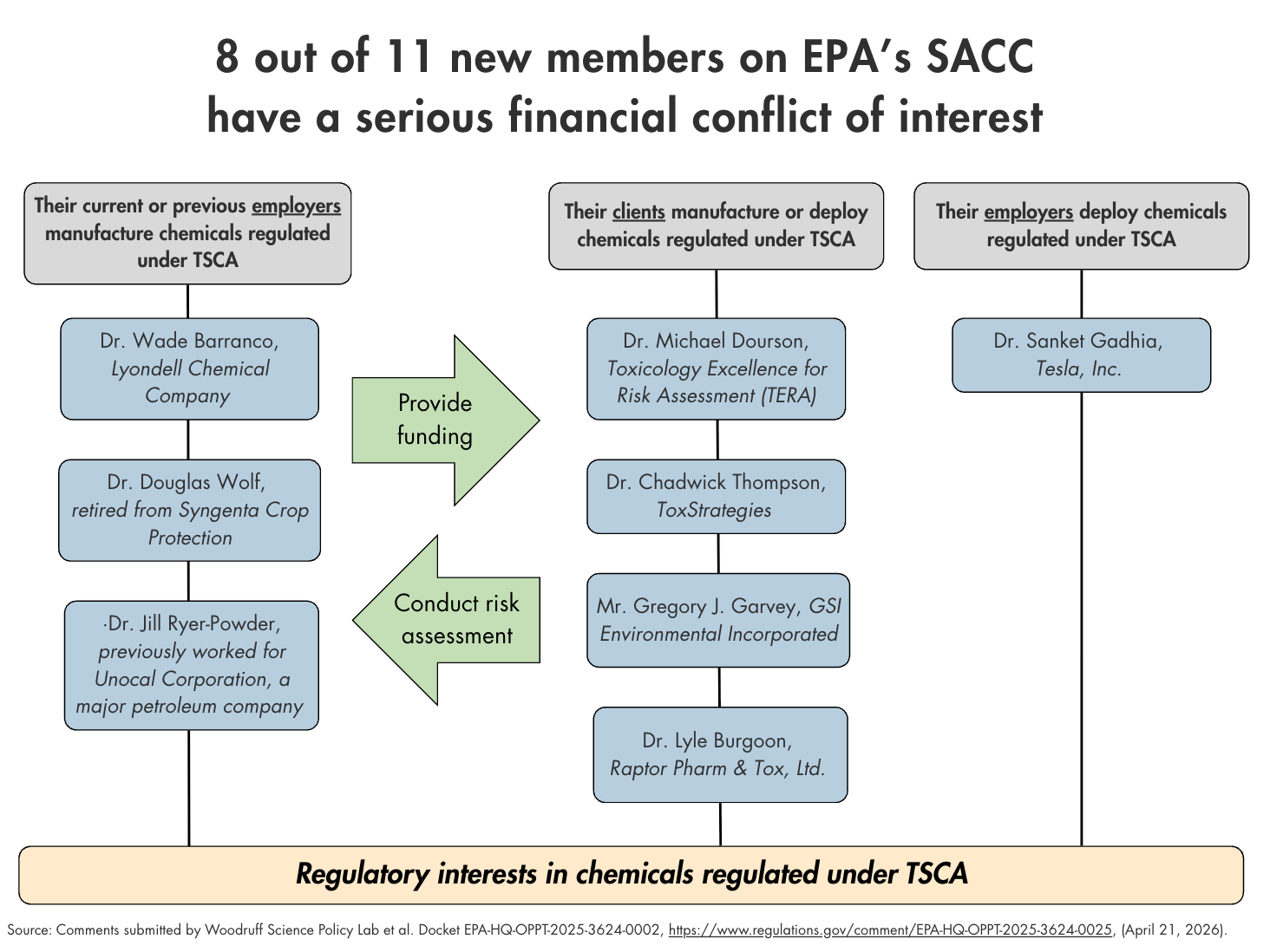
During the first Trump administration, the president’s nominee to head EPA’s Office of Chemical Safety and Pollution Prevention (OCSPP) was forced to withdraw his name from consideration after bipartisan opposition. Backlash stemmed from an extensive history of conducting industry-funded risk assessments that encouraged lax chemical safety standards.
Now, what if I told you that this same nominee, Michael Dourson, has recently been appointed to an influential science board within EPA?
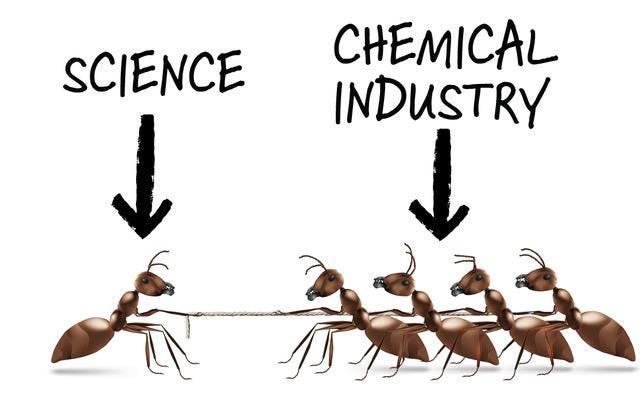
Most new SACC nominees are or were on industry payroll
EPA’s Science Advisory Committee on Chemicals (SACC) was established in 2016 under the Frank R. Lautenberg Chemical Safety for the 21st Century Act. This committee, typically comprised of 20-23 scientific experts, is charged with providing independent scientific guidance on EPA’s TSCA chemical risk evaluations. The SACC plays a vital role in shaping the Agency’s decisions about the health hazards and risks associated with chemicals and subsequent regulatory actions. Their assessments have highlighted concerns that EPA is not utilizing the best available science in its chemical evaluations.
This month, the SACC appointed 11 new members, including Dr. Dourson. Notably, among the new members, over 70% (8 out of 11) are members of or receive money from TSCA-regulated industries and/or the American Chemistry Council (ACC), an industry trade association for American chemical companies. Now, almost half of the SACC has a financial conflict of interest with the chemical industry (11 out of 23 total).
Corporate interests over public health
Research shows that financial conflicts of interest on advisory panels result in decisions that favor industry. Employees of chemical manufacturers should not serve as scientific advisors on the very panels responsible for evaluating their products. Similarly, consultants whose firms are compensated by regulated companies to represent them before EPA panels are unlikely to maintain neutrality in that role. If individuals with industry interests dominate the discussions, SACC recommendations are likely to consistently favor corporate interests over public health.
When forming federal advisory committees, EPA is responsible for ensuring that committees like the SACC reflect balanced interests by including members with diverse expertise and experiences. EPA is also responsible for identifying, disclosing, and mitigating potential conflicts of interest and sources of bias to prevent inappropriate influence over the committee’s judgment. The most effective way to minimize such bias is to avoid appointing financially conflicted individuals. However, these safeguards have not been implemented. In fact, several former members—such as George Cobb, Rainbow Rubin, and Francesca Merced, all experienced scientists and/or academics with no conflicts of interest—have been replaced by industry-aligned scientists.
The Trump administration’s appointment of industry scientists to the SACC illustrates a troubling trend of increasing corporate capture at EPA. Examples include former ACC lobbyist Nancy Beck and former American Cleaning Institute lobbyist Douglas Troutman, who now lead OCSPP. With the chemical industry now directly shaping the scientific review of TSCA chemical assessments, regulatory outcomes will favor industry, as we have already seen with formaldehyde.
Rushing the process
To make matters worse, Trump’s EPA has doubled down on efforts to limit the SACC’s ability to conduct meaningful scientific reviews. It normally takes months for the SACC to deliberate on the scientific validity of a single chemical risk assessment. However, in the past six months, EPA has inundated the SACC with nine chemical assessments, undermining the opportunity for comprehensive and rigorous reviews. Alarmingly, fewer than half of these assessments were complete when they were given to the SACC. This means that the committee could not effectively review EPA’s risk determinations for six of the nine chemicals evaluated.
Silencing public opinion
EPA has also limited the opportunity for public commenters to weigh in—a process that normally provides an additional layer of accountability and oversight of EPA’s assessments. The Health and Toxics Policy Lab recently submitted public comments to the SACC on five chemical assessments with only a 30-day timeline, half the time normally allotted for public commenting. This carefully orchestrated strategy of stacking the SACC with conflicted members, limiting public input, and inundating reviewers with assessments and unrealistic timelines has created a perfect storm that protects chemical industry profits, not health.
See public comments submitted by the Health and Toxics Policy Lab. Docket EPA-HQ-OPPT-2025-3624-0002, https://www.regulations.gov/comment/EPA-HQ-OPPT-2025-3624-0025, (April 21, 2026).